la belleza
resultado de la fricción
entre los sentido
y una realidad externa-interna
----lugar de la belleza: lugar de un encuentro entre territorios indomables----
jueves, 17 de junio de 2010

martes, 15 de junio de 2010
bion, esquizofrenia como panpsicopatología
La primera preocupación de Freud no fue delimitar neurosis y
psicosis, sino poner en evidencia la psicogénesis de toda una
serie de afecciones. A la inversa, Bion ubicó el paradigma de la
enfermedad mental en la esquizofrenia. Según él esta enfermedad
tiene como origen la intolerancia a la frustración. El paciente
huye de la frustración negándose a mentalizarla. Lo logra destruyendo
o invirtiendo la función alfa. También Bion encaró casi
toda la patología mental como trastornos del pensamiento.
http://www.apdeba.org/publicaciones/2000/02/articulos/022000bleandonu.pdf
psicosis, sino poner en evidencia la psicogénesis de toda una
serie de afecciones. A la inversa, Bion ubicó el paradigma de la
enfermedad mental en la esquizofrenia. Según él esta enfermedad
tiene como origen la intolerancia a la frustración. El paciente
huye de la frustración negándose a mentalizarla. Lo logra destruyendo
o invirtiendo la función alfa. También Bion encaró casi
toda la patología mental como trastornos del pensamiento.
http://www.apdeba.org/publicaciones/2000/02/articulos/022000bleandonu.pdf
bion, parte no-psicótica
Bion extendió este modelo para que pueda abarcar el
proceso de mentalización mismo. El punto primordial es que la
mente necesita del reverie materno para dejar de pensar en forma
concreta. Antes que la personalidad pueda disponer de una parte
no psicótica, es imperativo que haya logrado instalar en ella esta
capacidad de continencia y de transformación.
http://www.apdeba.org/publicaciones/2000/02/articulos/022000bleandonu.pdf
proceso de mentalización mismo. El punto primordial es que la
mente necesita del reverie materno para dejar de pensar en forma
concreta. Antes que la personalidad pueda disponer de una parte
no psicótica, es imperativo que haya logrado instalar en ella esta
capacidad de continencia y de transformación.
http://www.apdeba.org/publicaciones/2000/02/articulos/022000bleandonu.pdf
lunes, 14 de junio de 2010
gauguin, influences
Il (Paul Gauguin) cherche son inspiration dans l'art indigène, dans les vitraux médiévaux et les estampes japonaises.
---fr.wikipedia
---fr.wikipedia
viernes, 11 de junio de 2010
marcel mauss,,,,,,,,,,,, psicologçia y sociología
Mauss wrote extensively for the Journal of Normal and Pathological Psychology and served as president of the Society of Psychology from 1923 to 1926. He believed that data about primitive cultures were necessary to the science of psychology, and he wanted to facilitate exchange of information between it and sociology. He died on Feb. 10, 1950.
http://www.answers.com/topic/marcel-mauss
http://www.answers.com/topic/marcel-mauss
jueves, 10 de junio de 2010
viernes, 4 de junio de 2010
origen del deseo de ser analista
El análisis del deseo de ser analista, por medio del cual se troquela la escucha analítica, tiene que ver con momentos de profunda angustia infantil (Agustín Palacios, comunicación personal), con relación a aspectos de nuestras pulsiones parciales infantiles en los que nos jugábamos la vida, y ante las cuales generamos un estilo caracterológico específico, y que estamos obligados a intentar entender en el desempeño de nuestro trabajo.
Mireya Zapata Tarragona (APM)
http://www.apm.org.mx/Portal%20APM/cuadernos/2001/2001.html
Mireya Zapata Tarragona (APM)
http://www.apm.org.mx/Portal%20APM/cuadernos/2001/2001.html
miércoles, 2 de junio de 2010
textos, cantidad producida por la humanidad
The little Google search window would be the gateway to the content of the 32 million books, 750 million articles, 25 million songs, 500 million images, 500,000 films, 3 million television programs and 100 billion public Web pages that Wired writer Kevin Kelly estimates humanity has published since the days of Sumerian clay tablets. To store all of this gigantic volume of data -- estimated at 50 petabytes -- would still require a building the size of a small town's library, Kelly wrote in a 2006 article for the New York Times. But in the future, all of that knowledge will be only a mouse click away -- and will fit on a single iPod.
---------spiegel online, 2003
http://www.spiegel.de/international/business/0,1518,473529-2,00.html
---------spiegel online, 2003
http://www.spiegel.de/international/business/0,1518,473529-2,00.html
miércoles, 19 de mayo de 2010
otto rank
For each patient I need a different theory.
-----------Otto rank
http://www.ottorank.com/essays/the-evolution-of-psychotherapy-since-freud
-----------Otto rank
http://www.ottorank.com/essays/the-evolution-of-psychotherapy-since-freud
freud durante las sesiones
Often Freud would discuss books, theoretical points, even art and politics in the analytic hours.
----------------James Lieberman
http://www.ottorank.com/essays/the-evolution-of-psychotherapy-since-freud
----------------James Lieberman
http://www.ottorank.com/essays/the-evolution-of-psychotherapy-since-freud
sábado, 1 de mayo de 2010
hand-work
I love to do things with my hands.
So in America there is so much to do for fun; I do not understand those people who are sitting on their big cushions in front of T.V. and complaining.
--------victor belenko
http://www.fullcontext.org/people/belenko.htm
So in America there is so much to do for fun; I do not understand those people who are sitting on their big cushions in front of T.V. and complaining.
--------victor belenko
http://www.fullcontext.org/people/belenko.htm
lunes, 22 de marzo de 2010
glock
Back in 1981 Glock was producing plastic grenade shells for the Austrian army, in addition to plastic curtain-rod rings. One day he overheard two colonels complain that no gun existed that could meet their specifications. When Glock offered to make one, they laughed at him.
"You do not laugh at Mr. Glock," says Christopher Edwards, the burly former deputy sheriff of Jefferson County, Kentucky, who now runs Glock's training program in Smyrna, Georgia. "He takes that personally."
Glock never doubted he could make a superior gun. "That I knew nothing was my advantage," he says.
-------gaston glock
http://www.forbes.com/global/2003/0331/020_2.html
"You do not laugh at Mr. Glock," says Christopher Edwards, the burly former deputy sheriff of Jefferson County, Kentucky, who now runs Glock's training program in Smyrna, Georgia. "He takes that personally."
Glock never doubted he could make a superior gun. "That I knew nothing was my advantage," he says.
-------gaston glock
http://www.forbes.com/global/2003/0331/020_2.html
sábado, 20 de marzo de 2010
prostitución, siempre
"Pagamos por el sexo de una u otra forma... Al menos las prostitutas lo admiten."
----Tim Roth, en el primer capítulo de Lie to Me
----Tim Roth, en el primer capítulo de Lie to Me
domingo, 14 de marzo de 2010
tarifa y piel
La piel está disponible
pero no hay un horizonte de caricias
-salvo el que se puede comprar con 250 pesos
por veinte minutos-
pero no hay un horizonte de caricias
-salvo el que se puede comprar con 250 pesos
por veinte minutos-
sábado, 13 de marzo de 2010
miércoles, 10 de marzo de 2010
University of London External System
Referred to as "People's University" by Charles Dickens because it provided access to higher education to students from less affluent backgrounds, the External Programme was chartered by Queen Victoria in 1858, making the University of London the first university to offer distance learning degrees to students.
http://en.wikipedia.org/wiki/University_of_London_External_Programme
http://en.wikipedia.org/wiki/University_of_London_External_Programme
viernes, 5 de marzo de 2010
La palabra "palabra"
Mot ----francés
"Dans le langage courant, un mot est une suite de sons ou de caractères graphiques formant une unité sémantique et pouvant être distingués par un séparateur (blanc typographique à l'écrit, pause à l'oral)."
-------------fr.wikipedia.org
Word -----inglés
"A word is the smallest free form (an item that may be uttered in isolation with semantic or pragmatic content) in a language, in contrast to a morpheme, which is the smallest unit of meaning.
"Word may refer to a spoken word or a written word, or sometimes, the abstract concept behind either."
-----------------en.wikipedia.org
Parola ---------italiano
"Elemento basilare della comunicazione verbale, la parola assume in questa il ruolo di unità minima di trasmissione dei concetti e come tale è stata anche definita "monade logica""
----------------------it.wikipedia.org
Palavra -------------portugués
"O termo palavra deriva originalmente do grego parabolé, tomada emprestada pelo latim, que gerou parabola."
-----------------------pt.wikipedia.org
Palabra ----------aragonés
"Una palabra u parola ye, en gramatica tradizional, cadagún d'os segmentos que se troban entre dos pausas u espazios en a cadena fablata u escrita, que puet aparexer en atras posizions, e que tien una funzión."
------------------an.wikipedia.org
Verbum ---------latín
"Verbum (Graece λέξις) est minima orationis et scriptionis pars individua, quae proprium habet sensum."
----------------la.wikipedia.org
Pallabra --------------asturiano
"Discutióse muncho sobro la definición esauta del conceutu de 'pallabra. Espondremos darréu, el sentíu que se-y da davezu: Ye un segmentu de tira fónica que na escritura represéntase ente dos espacios consecutivos."
------------ast.wikipedia.org
"Dans le langage courant, un mot est une suite de sons ou de caractères graphiques formant une unité sémantique et pouvant être distingués par un séparateur (blanc typographique à l'écrit, pause à l'oral)."
-------------fr.wikipedia.org
Word -----inglés
"A word is the smallest free form (an item that may be uttered in isolation with semantic or pragmatic content) in a language, in contrast to a morpheme, which is the smallest unit of meaning.
"Word may refer to a spoken word or a written word, or sometimes, the abstract concept behind either."
-----------------en.wikipedia.org
Parola ---------italiano
"Elemento basilare della comunicazione verbale, la parola assume in questa il ruolo di unità minima di trasmissione dei concetti e come tale è stata anche definita "monade logica""
----------------------it.wikipedia.org
Palavra -------------portugués
"O termo palavra deriva originalmente do grego parabolé, tomada emprestada pelo latim, que gerou parabola."
-----------------------pt.wikipedia.org
Palabra ----------aragonés
"Una palabra u parola ye, en gramatica tradizional, cadagún d'os segmentos que se troban entre dos pausas u espazios en a cadena fablata u escrita, que puet aparexer en atras posizions, e que tien una funzión."
------------------an.wikipedia.org
Verbum ---------latín
"Verbum (Graece λέξις) est minima orationis et scriptionis pars individua, quae proprium habet sensum."
----------------la.wikipedia.org
Pallabra --------------asturiano
"Discutióse muncho sobro la definición esauta del conceutu de 'pallabra. Espondremos darréu, el sentíu que se-y da davezu: Ye un segmentu de tira fónica que na escritura represéntase ente dos espacios consecutivos."
------------ast.wikipedia.org
only maps
"the mental world is only maps of maps, ad infinitum."
-------Gregory Bateson
"Form, substance, and difference." 1972
-------Gregory Bateson
"Form, substance, and difference." 1972
miércoles, 3 de marzo de 2010
poema sin título
Más...
Más piel expuesta...
Más piel explorada (besada, mordida)...
Más música del verbo gemir...
Más cabello en el cabello
(y cabello en las manos, y largo cabello en todos los rostros del rostro)...
Y más... Y más.
Más piel expuesta...
Más piel explorada (besada, mordida)...
Más música del verbo gemir...
Más cabello en el cabello
(y cabello en las manos, y largo cabello en todos los rostros del rostro)...
Y más... Y más.
poema sin título
¿Quién fue?
¿Quién comenzó?
¿La lengua y sus exploraciones?...
¿Los vientres que se frotaban?...
¿La ropa fugitiva?...
¿Quién fue?..., me lo sigo preguntando.
¿Quién comenzó?
¿La lengua y sus exploraciones?...
¿Los vientres que se frotaban?...
¿La ropa fugitiva?...
¿Quién fue?..., me lo sigo preguntando.
poema sin título
Sembramos en la piel
árboles...
el deseo echó raíces...
las raíces nos trajeron asfixia...
el ahogo fue nuestro beso, nuestra desesperación.
árboles...
el deseo echó raíces...
las raíces nos trajeron asfixia...
el ahogo fue nuestro beso, nuestra desesperación.
typewriter and women's liberation
Sholes remarked of the typewriter, "I do feel that I have done something for the women who have always had to work so hard. This will enable them more easily to earn a living."
http://en.wikipedia.org/wiki/Sholes_and_Glidden_typewriter
http://en.wikipedia.org/wiki/Sholes_and_Glidden_typewriter
viernes, 26 de febrero de 2010
psicoanálisis como arte
Meltzer viewed psychoanalysis as an art form and essentially a process in which passion, personal commitment and the concern for patients were the main components of the “equipment” required for fostering their development.
http://www.psa-atelier.org/index.php?ul=0aa1458897789ed31c9cdc6fabf9567a
http://www.psa-atelier.org/index.php?ul=0aa1458897789ed31c9cdc6fabf9567a
psicoanálisis y arte
Meltzer's aesthetic interests, combined with the mother-baby model of early learning processes,[10] led to seeing psychoanalysis itself as an art form. His later works describe the relationship between analyst and analysand as an aesthetic process of symbol-making. This has had an influence on the philosophical view of the relation between art and psychoanalysis.[11]
-----wiki engl
-----wiki engl
jueves, 25 de febrero de 2010
el escritor ante la historia
Pour Albert Camus, soixante ans plus tard, l'écrivain « ne peut se mettre au service de ceux qui font l’histoire : il est au service de ceux qui la subissent »
"La vérité est mystérieuse, fuyante, toujours à conquérir. La liberté est dangereuse, dure à vivre autant qu’exaltante."
-----Albert Camus
Discours de Suède, Gallimard, 1958, p. 14, 59 et 19.
"La vérité est mystérieuse, fuyante, toujours à conquérir. La liberté est dangereuse, dure à vivre autant qu’exaltante."
-----Albert Camus
Discours de Suède, Gallimard, 1958, p. 14, 59 et 19.
lunes, 1 de febrero de 2010
domingo, 31 de enero de 2010
el culto a los osos

" Joseph Campbell goes so far as to suggest that the Bear Cult was older than shamanism by many centuries."
http://druidry.org/obod/theorder/archive/pcg-dao.html
martes, 22 de diciembre de 2009
jueves, 17 de diciembre de 2009
levi-strauss, misceláneo
http://www.liberation.fr/culture/0101601092-le-penseur-des-mondes-perdus
il travaille d’arrache-pied à la bibliothèque publique de New York, où il découvre des fonds ethnologiques très riches et entame sa thèse sur les Structures élémentaires de la parenté. «Je me suis senti assez vite homme de cabinet plutôt qu’homme de terrain»,
Lévi-Strauss ne rentre à Paris qu’en 1947. Quelques années plus tard, il refuse un poste à Harvard : «Je savais que j’appartenais par toutes mes fibres à l’Ancien Monde ; irrévocablement.»
En 1955, Tristes Tropiques marque un tournant : le professeur Lévi-Strauss, justement reconnu par ses pairs universitaires et chercheurs, devient un écrivain et savant mondialement connu. Ecrit à la demande de Jean Malaurie, lui-même ethnologue et directeur de la jeune collection Terre humaine, l’ouvrage tranche avec les précédents par son style et sa liberté de ton. Convaincu, après deux échecs au Collège de France, qu’il ne ferait pas de carrière universitaire, Claude Lévi-Strauss a accepté de «repenser ses aventures» et «d’écrire pour une fois sans précaution».
En 1962, dans la Pensée sauvage, il montre combien «la pensée à l’état sauvage, florissante dans tout esprit d’homme - contemporain ou ancien, proche ou lointain - tant qu’elle n’est pas cultivée et domestiquée pour accroître son rendement» n’a «rien de désordonné ni de confus», mais qu’au contraire, «partant d’une observation du monde qui témoigne d’une minutie et d’une précision stupéfiantes, elle analyse, distingue, classe, combine et oppose»
la musique, qui a été sans doute sa plus grande passion. Il voit un lien évident entre les mythes et la musique. Selon lui, «les structures mythiques préfiguraient à l’état latent les formes musicales»
il travaille d’arrache-pied à la bibliothèque publique de New York, où il découvre des fonds ethnologiques très riches et entame sa thèse sur les Structures élémentaires de la parenté. «Je me suis senti assez vite homme de cabinet plutôt qu’homme de terrain»,
Lévi-Strauss ne rentre à Paris qu’en 1947. Quelques années plus tard, il refuse un poste à Harvard : «Je savais que j’appartenais par toutes mes fibres à l’Ancien Monde ; irrévocablement.»
En 1955, Tristes Tropiques marque un tournant : le professeur Lévi-Strauss, justement reconnu par ses pairs universitaires et chercheurs, devient un écrivain et savant mondialement connu. Ecrit à la demande de Jean Malaurie, lui-même ethnologue et directeur de la jeune collection Terre humaine, l’ouvrage tranche avec les précédents par son style et sa liberté de ton. Convaincu, après deux échecs au Collège de France, qu’il ne ferait pas de carrière universitaire, Claude Lévi-Strauss a accepté de «repenser ses aventures» et «d’écrire pour une fois sans précaution».
En 1962, dans la Pensée sauvage, il montre combien «la pensée à l’état sauvage, florissante dans tout esprit d’homme - contemporain ou ancien, proche ou lointain - tant qu’elle n’est pas cultivée et domestiquée pour accroître son rendement» n’a «rien de désordonné ni de confus», mais qu’au contraire, «partant d’une observation du monde qui témoigne d’une minutie et d’une précision stupéfiantes, elle analyse, distingue, classe, combine et oppose»
la musique, qui a été sans doute sa plus grande passion. Il voit un lien évident entre les mythes et la musique. Selon lui, «les structures mythiques préfiguraient à l’état latent les formes musicales»
estructura del mito
Pour démontrer que les mythes, ces récits premiers et fondateurs, ne doivent rien à la fantaisie ni à l’arbitraire mais au contraire à la reproduction plus ou moins conforme d’invariants et de schèmes, le chercheur y transcrit, interprète et compare plus de 800 mythes amérindiens et d’un millier de leurs variantes. Le mythe est cette parole structurante qui a survécu au temps, qui assure la continuité du groupe et de l’espèce.
--IBID
--IBID
sin escritura
Une fois sa thèse passée, il est élu en 1950 directeur d’études à l’Ecole pratique des hautes études. Face à la protestation d’étudiants africains, il transforme l’intitulé de sa chaire, «Religions des peuples non civilisés», en «Religions des peuples sans écriture».
http://www.liberation.fr/culture/0101601012-levi-strauss-un-deracine-chronique
http://www.liberation.fr/culture/0101601012-levi-strauss-un-deracine-chronique
levi-strauss, et lacan
Lévi-Strauss ne rentre à Paris qu’en 1947. Affecté au Musée de l’Homme, il rencontre Georges Dumézil, Michel Leiris dont il lit l’œuvre «avec délectation», et Jacques Lacan, en qui il voit un «chaman» des sociétés modernes.
http://www.liberation.fr/culture/0101601012-levi-strauss-un-deracine-chronique
http://www.liberation.fr/culture/0101601012-levi-strauss-un-deracine-chronique
claude levi-strauss y los pantalones de mezclilla
il est rapidement révoqué du fait des lois raciales de Vichy. Il choisit et obtient un poste à la New School for Social Research de New York, un centre d’accueil pour intellectuels européens persécutés par le nazisme et commence à enseigner, sous le nom de Claude L. Strauss, comme on le lui demande à cause de la marque de blue-jeans: «Je vécus ainsi plusieurs années aux Etats-Unis sous un patronyme mutilé. Depuis, cette malheureuse homonymie n’a cessé de me hanter. Tel un fantôme. Il ne se passe guère d’année sans que je reçoive, en général d’Afrique, une commande de jeans».
http://www.liberation.fr/culture/0101601012-levi-strauss-un-deracine-chronique
http://www.liberation.fr/culture/0101601012-levi-strauss-un-deracine-chronique
domingo, 13 de diciembre de 2009
locura y psicoanálisis
Entonces, la salud mental tampoco existe. Frente al montaje de ideales de salud mental colectivos, Lacan enunciaba proposiciones provocadoras, como "todo el mundo está loco".
Eric Laurent
http://virtualia.eol.org.ar/019/template.asp?dossier/laurent.html
Eric Laurent
http://virtualia.eol.org.ar/019/template.asp?dossier/laurent.html
sábado, 12 de diciembre de 2009
no-saber
la paradoja de que lo más importante de la Escuela no es lo que ella sabe sino lo que sabe que no sabe, lo más precioso del saber de la Escuela es que ella sabe que no sabe.
***
Crear una Escuela significa estar dispuesto, en todo momento, a sacrificar la institución, si es necesario, en favor del psicoanálisis. Lacan demostró esto sacrificando su Escuela cuando le pareció que ya no estaba funcionando para el psicoanálisis
***
El análisis es una profesión delirante, en la medida en que es pos ible encontrar entre los analistas a aquellos que piensan que están solos , pues la propia experiencia analítica lo favorece, por el hecho de que e n su consultorio el analista es analista sólo cuando analiza; es por eso que los analistas son proclives a llevar su subjetividad a lo absoluto.
****
La respuesta de Lacan fue sustituir las Sociedades por la Escuela, una institución cuya particularidad es la de no saber algo esencial, no saber qué es un analista.
******
Estoy esperando que en estas jornadas ocurra una discusión muy precisa para que se sepa si cada uno está preparado para sacrificar el goce de las rivalidades y de las oposiciones por una Escuela. La pregunta es: ¿el goce que se puede obtener de la Escuela podrá ser más fuerte que el goce que se obtiene al debatir y al herir al enemigo vencido? Tenemos que esperar para ver si eso se produce; antes de eso no podemos decir nada.
*****
Horacio Etchegoyen, futuro presidente de la IPA, es mi amigo. Cuando le preguntaron cuál era él tema que la IPA va a trabajar en el futuro, respondió: "La diferencia entre transferencia y repetición, que es un punto que Lacan señaló en 1964 y que él aprendió de mis conferencias caraqueñas del '80, 1o cual es muy simpático de su parte, pero no implica que tengamos tantas cosas para aprender.
----Jacques A. Milller
http://www.wapol.org/fr/las_escuelas/TemplateArticulo.asp?intTipoPagina=4&intEdicion=1&intIdiomaPublicacion=5&intArticulo=289&intIdiomaArticulo=1&intPublicacion=10
***
Crear una Escuela significa estar dispuesto, en todo momento, a sacrificar la institución, si es necesario, en favor del psicoanálisis. Lacan demostró esto sacrificando su Escuela cuando le pareció que ya no estaba funcionando para el psicoanálisis
***
El análisis es una profesión delirante, en la medida en que es pos ible encontrar entre los analistas a aquellos que piensan que están solos , pues la propia experiencia analítica lo favorece, por el hecho de que e n su consultorio el analista es analista sólo cuando analiza; es por eso que los analistas son proclives a llevar su subjetividad a lo absoluto.
****
La respuesta de Lacan fue sustituir las Sociedades por la Escuela, una institución cuya particularidad es la de no saber algo esencial, no saber qué es un analista.
******
Estoy esperando que en estas jornadas ocurra una discusión muy precisa para que se sepa si cada uno está preparado para sacrificar el goce de las rivalidades y de las oposiciones por una Escuela. La pregunta es: ¿el goce que se puede obtener de la Escuela podrá ser más fuerte que el goce que se obtiene al debatir y al herir al enemigo vencido? Tenemos que esperar para ver si eso se produce; antes de eso no podemos decir nada.
*****
Horacio Etchegoyen, futuro presidente de la IPA, es mi amigo. Cuando le preguntaron cuál era él tema que la IPA va a trabajar en el futuro, respondió: "La diferencia entre transferencia y repetición, que es un punto que Lacan señaló en 1964 y que él aprendió de mis conferencias caraqueñas del '80, 1o cual es muy simpático de su parte, pero no implica que tengamos tantas cosas para aprender.
----Jacques A. Milller
http://www.wapol.org/fr/las_escuelas/TemplateArticulo.asp?intTipoPagina=4&intEdicion=1&intIdiomaPublicacion=5&intArticulo=289&intIdiomaArticulo=1&intPublicacion=10
jueves, 19 de noviembre de 2009
behind the scenes and freedom
I really like the behind the scenes role, because all my freedom is there.
--------brian eno
http://music.hyperreal.org/artists/brian_eno/interviews/musn79.html
jueves, 22 de octubre de 2009
miércoles, 21 de octubre de 2009
más suave
pieza: softer, softest (live performance)
artista: courtney love
(Descalza, sola, con su guitarra, frente a una multitud.)
artista: courtney love
(Descalza, sola, con su guitarra, frente a una multitud.)
sábado, 5 de septiembre de 2009
lunes, 31 de agosto de 2009
animal
"¡Hablar, hablar, hablar!... ¡La gente se la pasa hablando! Los animales no hablan, por eso no mienten."
----------La prostituta q sale en la peli BREAKING AND ENTERING
----------La prostituta q sale en la peli BREAKING AND ENTERING
cetáceo
"Una vez me retaron a filmar MOBY DICK desde el punto de vista de la ballena... Mi película recaudó 400 millones de dólares por todo el mundo."
-----El personaje q hace Dustin Hoffman, en WAG THE DOG
-----El personaje q hace Dustin Hoffman, en WAG THE DOG
circunstancias
"No existe eso q la gente llama problemas. Sólo hay situaciones."
---------De la película Revolver, de Guy Ritchie.
---------De la película Revolver, de Guy Ritchie.
afrenta
HOMERO: No te preocupes, hijo. Yo te construiré una casa-de-árbol tan grande que ¡será una afrenta para el mismo Dios!
BART: ¿Y puede tener una escalera plegable?
HOMERO: Sólo si es una afrenta para Dios.
BART: ¿Y puede tener una escalera plegable?
HOMERO: Sólo si es una afrenta para Dios.
jueves, 27 de agosto de 2009
Executive Producer
EL DUEÑO DE UN ESTUDIO: "¿Y quién demonios es usted?"
HOMERO SIMPSON: "¿El término PRODUCTOR EJECUTIVO le dice algo?"
MEL GIBSON: "¡¿Productor ejecutivo?!"
HOMERO SIMPSON: "¿El término PRODUCTOR EJECUTIVO le dice algo?"
MEL GIBSON: "¡¿Productor ejecutivo?!"
lunes, 24 de agosto de 2009
melissa, siempre
pieza: malibu
artista: hole (live performance)
(En esta versión, hay un juego de cámaras entre el rostro de Curtney y el hermoso rostro de Mellissa Auf der Maur, más o menos hacia el final de la canción.)
artista: hole (live performance)
(En esta versión, hay un juego de cámaras entre el rostro de Curtney y el hermoso rostro de Mellissa Auf der Maur, más o menos hacia el final de la canción.)
domingo, 23 de agosto de 2009
con mayor razón...
-¿Y si candidateamos al Presidente para el Nobel de la Paz?
-Bueno, pues si Henrry Kissinger lo ganó...
-Pero, nuestro hombre sí trajo la paz.
-Oye, pero no había guerra.
-Pues eso le da mayor mérito.
-----------Diálogo entre Hoffmman y De Niro, en WAG THE DOG
-Bueno, pues si Henrry Kissinger lo ganó...
-Pero, nuestro hombre sí trajo la paz.
-Oye, pero no había guerra.
-Pues eso le da mayor mérito.
-----------Diálogo entre Hoffmman y De Niro, en WAG THE DOG
necesario
"No puedes tener una guerra sin un enemigo... Bueno, se podría, pero sería una guerra muy aburrida."
-----El personaje de Robert DeNiro en la peli WAG THE DOG
-----El personaje de Robert DeNiro en la peli WAG THE DOG
lunes, 17 de agosto de 2009

viernes, 7 de agosto de 2009
in the enosphere,,,,,,,,,,Franck Mallet 2001
http://music.hyperreal.org/artists/brian_eno/interviews/artpress01.html
"It's a particular color, ambient music is intended to induce calm and a space to think. Ambient music must be able to accommodate many levels of listening attention without enforcing one in particular."
It's strange to think a piece I recorded in two and a half days has aquired a kind of immortality. I thought it would be ephemeral. But it has a new life beyond the record. A part of me has become immortal, out of my control.
Nobody had really thought about this question, and yet we are increasingly likely to find ourselves in places with background music, an ambience. Still, no composers have thought to write for these modern spaces which represent 30% of our current musical experience.
I dreamed of a music without barriers, taking in classical instruments, new electronic instruments and "non-instruments"
I have always learnt things out of fascination.
For ten years Music For Airports was dismissed as crap!
People wanted to create a sound world using the studio, and not just to tell a story.
Music is my true home!
but when you study music in the classical system, you are always on the inside.
"It's a particular color, ambient music is intended to induce calm and a space to think. Ambient music must be able to accommodate many levels of listening attention without enforcing one in particular."
It's strange to think a piece I recorded in two and a half days has aquired a kind of immortality. I thought it would be ephemeral. But it has a new life beyond the record. A part of me has become immortal, out of my control.
Nobody had really thought about this question, and yet we are increasingly likely to find ourselves in places with background music, an ambience. Still, no composers have thought to write for these modern spaces which represent 30% of our current musical experience.
I dreamed of a music without barriers, taking in classical instruments, new electronic instruments and "non-instruments"
I have always learnt things out of fascination.
For ten years Music For Airports was dismissed as crap!
People wanted to create a sound world using the studio, and not just to tell a story.
Music is my true home!
but when you study music in the classical system, you are always on the inside.
miércoles, 5 de agosto de 2009
la revancha de lo intuitivo,,,,,,brian eno,,,,,,1999,,,,,,excerpts
http://www.wired.com/wired/archive/7.01/eno.html
But now I'm struck by the insidious, computer-driven tendency to take things out of the domain of muscular activity and put them into the domain of mental activity. This transfer is not paying off. Sure, muscles are unreliable, but they represent several million years of accumulated finesse. Musicians enjoy drawing on that finesse (and audiences respond to its exercise), so when muscular activity is rendered useless, the creative process is frustrated.
In my experience, the instruments and tools that endure (because they are loved by their users) have limited options.
Indeed, familiarity breeds content. When you use familiar tools, you draw upon a long cultural conversation - a whole shared history of usage - as your backdrop, as the canvas to juxtapose your work.
But now I'm struck by the insidious, computer-driven tendency to take things out of the domain of muscular activity and put them into the domain of mental activity. This transfer is not paying off. Sure, muscles are unreliable, but they represent several million years of accumulated finesse. Musicians enjoy drawing on that finesse (and audiences respond to its exercise), so when muscular activity is rendered useless, the creative process is frustrated.
In my experience, the instruments and tools that endure (because they are loved by their users) have limited options.
Indeed, familiarity breeds content. When you use familiar tools, you draw upon a long cultural conversation - a whole shared history of usage - as your backdrop, as the canvas to juxtapose your work.
brian eno,,,,,,,wired interview,,,,,2007
http://www.wired.com/culture/art/news/2007/07/eno_qa_full?currentPage=all
But the breakthrough for me -- I happened to start working in studios just at the time that multi-tracking became available, and I realized it made music-making a lot like painting in that you could add and take away colors, you could stretch things and turn them upsidedown and do all sorts of different things. So I thought of myself as a sonic painter rather than as a composer.
So, it was always really trying to pick technologies that were around and seeing what else you could do with them. You know, I think that technology is always invented for historical reasons, to solve a historical problem. But they very soon reveal themselves to be capable of doing things that aren't historical that nobody had ever thought of doing before.
But the breakthrough for me -- I happened to start working in studios just at the time that multi-tracking became available, and I realized it made music-making a lot like painting in that you could add and take away colors, you could stretch things and turn them upsidedown and do all sorts of different things. So I thought of myself as a sonic painter rather than as a composer.
So, it was always really trying to pick technologies that were around and seeing what else you could do with them. You know, I think that technology is always invented for historical reasons, to solve a historical problem. But they very soon reveal themselves to be capable of doing things that aren't historical that nobody had ever thought of doing before.
brian eno 2002
http://www.indexmagazine.com/interviews/brian_eno.shtml
"I recently read Richard Sennett’s book The Uses of Disorder. It’s a very intelligent anti-planning book, and I thought, “This is fantastic, but nobody’s ever going to read it.” So I decided to condense it. I wanted to present the argument of the book in three thousand words. I went through it with a yellow highlighter, marking the bits that really got the germ of the idea. Then I photocopied all the parts I’d marked and collaged them together. After that, I had this idea that every serious book should be publishedin two forms. There should be the full version, but preceding it by a month or so should be the filtered version."
"...the introduction to his book Contingency, Irony, and Solidarity. It’s only a few pages long and it’s so good. The book is about Nabakov and Orwell, and about writing and the idea that works of imagination are the way that we arrive at new social concepts, rather than works of so-called rational deduction. In the end, what Rorty turns out to be saying is that philosophy is just another kind of writing. It doesn’t have any special grasp on the truth."
"One often used to hear high art people saying that pop music was so boring and formulaic. I never thought that was true. All that formula and repetition is like a great big vehicle for carrying the moment of difference — the tiny point where something happens that didn’t happen before. As a listener, the first question I ask myself is, “Why am I moved by that? Why does that difference matter to me?”
"If something I do gets criticized, I would never say, “They didn’t understand me,” or “What I did was too good for them.” I would assume there was something wrong with what I was doing."
"I’ve often thought that there are two varieties of artists. There’s the fussy type, which I tend to be, who always censor themselves, and then there are people like Miles Davis and Prince who just say, “Look, if it came from me, it’s probably good.” "
"A few years ago I was interested in what was happening to the act of curating. I’d seen a few shows in Europe, particularly in France and Germany, where the name of the curator was bigger on the poster than the names of the artists. It’s like saying, “Here’s somebody who can draw an interesting line through our culture. He can connect a few things which you’ll probably find worth taking seriously.”
"As an English person living in America in the early-’80s, I was much more receptive than a native would have been. I didn’t have many friends there, so I would just listen to the radio. There were complete lunatics on the airwaves — people whose views seemed so objectionable. I started recording them just because I wanted to show my friends in England what people in America were listening to."
"Things always look much more calculated in retrospect. I agree that you can draw a line through the things that I did, but at the time they all seemed chaotic to me. "
PETER HALLEY: I’m such a workaholic that the only way I can even make friends with people is by interviewing them. [laughs]
BRIAN: I make most of my friends through working situations as well.
PETER: That’s said to be a skill that’s prominent in women.
BRIAN: Yes. It led me to my theory that cities are places built for women.
PETER: Wow.
BRIAN: In cities, you have the opportunity to do all the things that women are really specialized at: intense social relationships and interactions, attention to lots of simultaneous details. And of course in cities you can do very few of the things that men are good at.
PETER: Like what?
BRIAN: You can’t break anything in a city. Everything is valuable, so you’re limited in how much you can test the physical nature of things — which I think is a big part of a man’s make up.
"I recently read Richard Sennett’s book The Uses of Disorder. It’s a very intelligent anti-planning book, and I thought, “This is fantastic, but nobody’s ever going to read it.” So I decided to condense it. I wanted to present the argument of the book in three thousand words. I went through it with a yellow highlighter, marking the bits that really got the germ of the idea. Then I photocopied all the parts I’d marked and collaged them together. After that, I had this idea that every serious book should be publishedin two forms. There should be the full version, but preceding it by a month or so should be the filtered version."
"...the introduction to his book Contingency, Irony, and Solidarity. It’s only a few pages long and it’s so good. The book is about Nabakov and Orwell, and about writing and the idea that works of imagination are the way that we arrive at new social concepts, rather than works of so-called rational deduction. In the end, what Rorty turns out to be saying is that philosophy is just another kind of writing. It doesn’t have any special grasp on the truth."
PETER: I’d like to bring up Norbert Elias again. In one of his books, he kind of refutes the idea of individual consciousness. He says consciousness only resides in the group. That seemed enormously important to me.
BRIAN: I recently read a book about the CIA’s experiments in the ‘60s and ‘70s using psychedelic drugs as interrogation tools. In the end, they found that what worked best was old-fashioned solitary confinement. It drove the subjects completely mad.
PETER: It seems that almost the biggest pain humans can feel is total aloneness.
BRIAN: Occasionally I go off for a few days just to sit somewhere on my own. I refer to it as “going into the abyss.”"One often used to hear high art people saying that pop music was so boring and formulaic. I never thought that was true. All that formula and repetition is like a great big vehicle for carrying the moment of difference — the tiny point where something happens that didn’t happen before. As a listener, the first question I ask myself is, “Why am I moved by that? Why does that difference matter to me?”
"If something I do gets criticized, I would never say, “They didn’t understand me,” or “What I did was too good for them.” I would assume there was something wrong with what I was doing."
"I’ve often thought that there are two varieties of artists. There’s the fussy type, which I tend to be, who always censor themselves, and then there are people like Miles Davis and Prince who just say, “Look, if it came from me, it’s probably good.” "
"A few years ago I was interested in what was happening to the act of curating. I’d seen a few shows in Europe, particularly in France and Germany, where the name of the curator was bigger on the poster than the names of the artists. It’s like saying, “Here’s somebody who can draw an interesting line through our culture. He can connect a few things which you’ll probably find worth taking seriously.”
"As an English person living in America in the early-’80s, I was much more receptive than a native would have been. I didn’t have many friends there, so I would just listen to the radio. There were complete lunatics on the airwaves — people whose views seemed so objectionable. I started recording them just because I wanted to show my friends in England what people in America were listening to."
"Things always look much more calculated in retrospect. I agree that you can draw a line through the things that I did, but at the time they all seemed chaotic to me. "
martes, 4 de agosto de 2009
behind scenes
I really like the behind the scenes role, because all my freedom is there.
http://music.hyperreal.org/artists/brian_eno/interviews/musn79.html#musician
http://music.hyperreal.org/artists/brian_eno/interviews/musn79.html#musician
nature fabric
"I get steadily more interested in the idea that here's nature, the fabric of things or the ongoing current or whatever, and what you can do is just ride on that system, and the amount of interference you need to make can sometimes be very small."
http://music.hyperreal.org/artists/brian_eno/interviews/musn79.html#musician
http://music.hyperreal.org/artists/brian_eno/interviews/musn79.html#musician
can't understand
It's like David Byrne said to me the other day: 'Sometimes I write something that I really can't understand, and that's what excites me.' I felt such a sympathy with that position.
"writing" lyrics
"So what I do first is work on the track till its identity is fairly well established, I already know how its gonna sound in terms of textures and time and speed and all that, then I take all that home, a rough mix version of it and I just keep playing it very loud and just singing along with them just singing anything really, and sometimes that anything is just right for it. It s the only thing I do, I guess, that approaches improvising, because everything else is very pedestrian in the way it's made. What often happens is that I get an idea of how the words will fall and what their function be rhythmically, so I start singing or placing the syllables in a certain way, and they're just nonsense at the beginning. Then certain types of sounds will emerge, like a particular vowel sound will suit a particular song. Like, for some reason, the vowel sound 'i' suited 'Baby's on Fire,' it's a sharp kind of thin sound; so then I'm working around two things, which is this vowel sound and this syllable construction, and quite soon words arise from that, and you only need to get about six words out of that for you then to have a good clue of what the song is going to be about. And I know it sounds extremely perverse whenever I explain it, to finally at the end of it all sit down and read it and say, 'Ah, so that's what it's about.' But what strikes me is that following this process, the preoccupations that manifest are not ones that you're necessarily conscious of at any earlier point."
http://music.hyperreal.org/artists/brian_eno/interviews/musn79.html#musician
http://music.hyperreal.org/artists/brian_eno/interviews/musn79.html#musician
musicanción
You see, the problem is that people, particularly people who write, assume that the meaning of a song is vested in the lyrics. To me, that has never been the case
--------brian eno
http://music.hyperreal.org/artists/brian_eno/interviews/musn79.html#musician
--------brian eno
http://music.hyperreal.org/artists/brian_eno/interviews/musn79.html#musician
musilyrics
With the lyrics I have all these tricks and techniques which were first conceived as a way of defeating self-consciousness about writing lyrics, and because I don't have anything to say in the usual sense. I prefer to let the music prompt something from me. See what that prompts and then examine it after the event.
------------brian eno
http://music.hyperreal.org/artists/brian_eno/interviews/musn79.html#musician
------------brian eno
http://music.hyperreal.org/artists/brian_eno/interviews/musn79.html#musician
fuck the trainning
"One of the interesting things about having little musical knowledge is that you generate surprising results sometimes."
--------brian eno
http://music.hyperreal.org/artists/brian_eno/interviews/musn79.html#musician
--------brian eno
http://music.hyperreal.org/artists/brian_eno/interviews/musn79.html#musician
no-manual
"...so strictly speaking I'm a non-musician. None of my skills are manual, they're not to do with manipulation in that sense, they're more to do with ingenuity, I suppose."
-----------brian eno
http://music.hyperreal.org/artists/brian_eno/interviews/musn79.html#musician
-----------brian eno
http://music.hyperreal.org/artists/brian_eno/interviews/musn79.html#musician
fun, building
"Nearly all the things I do that are of any merit at all start off all just being good fun, and, I think, um, I'm sort of building up to doing something else quite soon."
------------brian eno
http://music.hyperreal.org/artists/brian_eno/interviews/musn79.html#tape
------------brian eno
http://music.hyperreal.org/artists/brian_eno/interviews/musn79.html#tape
musijungla
"...it's a sort of jungle sound, really."
-------------brian eno
http://music.hyperreal.org/artists/brian_eno/interviews/musn79.html#tape
-------------brian eno
http://music.hyperreal.org/artists/brian_eno/interviews/musn79.html#tape
recordar a mcluhan
Everybody thinks that when new technologies come along that they're transparent and you can just do your job well on it. But technologies always import a whole new set of values with them.
----------brian eno
----------brian eno
primero, muerto
"Of course, they want another Nevermind, but I'd rather die than do that."
----------------------kurt cobain
http://en.wikipedia.org/wiki/In_Utero
----------------------kurt cobain
http://en.wikipedia.org/wiki/In_Utero
domingo, 2 de agosto de 2009
prosticel
Mi celular es como las prostitutas: siempre cobra más de lo acordado, entrega menos de lo prometido, y se la pasa apurándome para que "ya termine".
sábado, 1 de agosto de 2009
la apasionada ejecución de la bajista kristen pfaff
pieza: gutless (life performance)
artista: hole
(el video y el audio tienen pobre calidad técnica, pero con la grandísima ventaja de que está en primer plano, todo el tiempo, la hermosa bajista kristen pfaff, fallecida en 1994, a los 27 años de edad.)
artista: hole
(el video y el audio tienen pobre calidad técnica, pero con la grandísima ventaja de que está en primer plano, todo el tiempo, la hermosa bajista kristen pfaff, fallecida en 1994, a los 27 años de edad.)
viernes, 31 de julio de 2009
melissa auf der maur....in her words
http://melissaaufdermaur.org/content/page/10/quotes_by_melissa
"All of us are half men and half women we have just as much masculine as feminine, so I would definitely describe the new project as me wrestling with those two sides."
"I sold my life to Capitol Records; it sucks."
"I mean, the way I see it is, every penny I've ever made through music is free money."
"I am still making up songs in my head and on my answering machine."
"I must've been a rastafarian in a previous life. They think their hair is an extension of themselves, and every time I get mine cut, I cry. My mother is a big Bob Marley fan. Maybe that explains it. "
"I'm glad I spent a chapter of my life there to really get to know the ugly beauty of the American dream."
"The bass is the mother of all instruments."
"I get so into it. The only time I ever feel the same way is when I'm having sex; it's the epitome of unifying with something."
-Melissa on playing bass
"I do fuck, but i don't say fuck"
-Melissa after Courtney tries to get the audience to get Melissa to say fuck
"Canadian red-head, believes in aliens or other worlds. Likes sexy rock music. You must be able to take acid and not freak out."
-Personal ad
"I was just considering to start playing bass, and when I saw D'arcy playing those Gish songs, with these wacked out, kinda trippy guys, I just thought: I want to be this girl."
"I have to point out that I was born on St. Patrick's day and that both my parents have black hair and that I came out redheaded and pale. I mean I have lots of Irish in my blood, so it makes sense, but the redhead gene is a completely schizophrenic, chaotic DNA thing that makes no sense at all. they just come up whenever. there's no predicting it. scientists can't pin it down. so it's always been kind of a big hang up of mine. when I was a kid, I thought it was gross. and I was like, "i wanna be like everyone else. Please take away this red hair." but then throughout the years, I realized it was special. Someone gave me— I think a makeup artist —this scientific explanation that our pigment is fucked up and something we have reacts weird to the sun so freckles are the reaction. sometimes if I'm on mushrooms or something and I look in the mirror, I look green and I feel like there's major yellow. the moral of the story is that supposedly redheads have a wider color spectrum in their skin. there's green, blue, purple and brown in my skin so supposedly we can wear more colors than most people."
"All of us are half men and half women we have just as much masculine as feminine, so I would definitely describe the new project as me wrestling with those two sides."
"I sold my life to Capitol Records; it sucks."
"I mean, the way I see it is, every penny I've ever made through music is free money."
"I am still making up songs in my head and on my answering machine."
"I must've been a rastafarian in a previous life. They think their hair is an extension of themselves, and every time I get mine cut, I cry. My mother is a big Bob Marley fan. Maybe that explains it. "
"I'm glad I spent a chapter of my life there to really get to know the ugly beauty of the American dream."
"The bass is the mother of all instruments."
"I get so into it. The only time I ever feel the same way is when I'm having sex; it's the epitome of unifying with something."
-Melissa on playing bass
"I do fuck, but i don't say fuck"
-Melissa after Courtney tries to get the audience to get Melissa to say fuck
"Canadian red-head, believes in aliens or other worlds. Likes sexy rock music. You must be able to take acid and not freak out."
-Personal ad
"I was just considering to start playing bass, and when I saw D'arcy playing those Gish songs, with these wacked out, kinda trippy guys, I just thought: I want to be this girl."
"I have to point out that I was born on St. Patrick's day and that both my parents have black hair and that I came out redheaded and pale. I mean I have lots of Irish in my blood, so it makes sense, but the redhead gene is a completely schizophrenic, chaotic DNA thing that makes no sense at all. they just come up whenever. there's no predicting it. scientists can't pin it down. so it's always been kind of a big hang up of mine. when I was a kid, I thought it was gross. and I was like, "i wanna be like everyone else. Please take away this red hair." but then throughout the years, I realized it was special. Someone gave me— I think a makeup artist —this scientific explanation that our pigment is fucked up and something we have reacts weird to the sun so freckles are the reaction. sometimes if I'm on mushrooms or something and I look in the mirror, I look green and I feel like there's major yellow. the moral of the story is that supposedly redheads have a wider color spectrum in their skin. there's green, blue, purple and brown in my skin so supposedly we can wear more colors than most people."
melissa auf der maur...."but I will be"
http://melissaaufdermaur.org/content/page/5/biography
Her father bought her her first bass(A japanese Fender Squier) for her 21st birthday. "At that time I was going up to the local punk bands and asked if I could jam with them. 'Well', they said, 'Are you any good?' and I said, 'No, but I will be.'"
Her father bought her her first bass(A japanese Fender Squier) for her 21st birthday. "At that time I was going up to the local punk bands and asked if I could jam with them. 'Well', they said, 'Are you any good?' and I said, 'No, but I will be.'"
courtney love,,,,,,,por caitlin moran
http://www.timesonline.co.uk/tol/life_and_style/article630036.ece
But, as Love herself is the first to admit, “My press is disproportionate to the amount that I’ve done.”
“My mother told me she tried to abort me, and that I was the result of a rape. My dad says my mother was high on acid. I was raised by wolves.” She shrugs — maybe she has heard R. D. Laing’s aphorism, about character being conditioned by the fuck that made you.
“The language of love letters/Is the same/As suicide notes."
But, as Love herself is the first to admit, “My press is disproportionate to the amount that I’ve done.”
“My mother told me she tried to abort me, and that I was the result of a rape. My dad says my mother was high on acid. I was raised by wolves.” She shrugs — maybe she has heard R. D. Laing’s aphorism, about character being conditioned by the fuck that made you.
“The language of love letters/Is the same/As suicide notes."
courtney love,,,,,,,,,por laura barton
http://www.guardian.co.uk/film/2006/dec/11/biography.popandrock
"What does the man that I married have any fucking thing to do with my experience as a woman? Other than completely destroying half my life?"
"Kim Gordon [of Sonic Youth] sits me down and says, 'If you marry him your life is not going to happen, it will destroy your life.' But I said, 'Whatever, I love him, and I want to be with him!'" Love hesitates. "It wasn't his fault. He wasn't trying to do that."
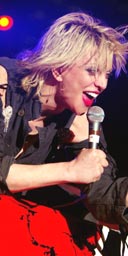
"What does the man that I married have any fucking thing to do with my experience as a woman? Other than completely destroying half my life?"
"Kim Gordon [of Sonic Youth] sits me down and says, 'If you marry him your life is not going to happen, it will destroy your life.' But I said, 'Whatever, I love him, and I want to be with him!'" Love hesitates. "It wasn't his fault. He wasn't trying to do that."
Love me do
She's been a stripper, an actor, an addict, a rock star and, since 1994, the seriously troubled widow of Kurt Cobain. Here, she talks to Laura Barton about her 'transgressions', the day Johnny Depp saved her life, and why she's been blacklisted by Hollywood.
-

- The Guardian, Monday 11 December 2006
- Article history
Burning, but not out ... Courtney Love in 2004. Photograph: Scott Gries/Getty
She is wearing a pussycat-bow blouse, sipping lapsang souchong, her eyes tilted down demurely over her china cup. Poised in all her silken finery, the figure once described by Rolling Stone magazine as "the most controversial woman in the history of rock" is barely recognisable. As much as we think we know who Courtney Love is, nothing prepares you for the sprawling intelligence or the keen beauty of her. Love is not like most female celebrities. She is bigger than that. Her hands are meaty and her eyes enormous, her bosom has been surgically enhanced and her lips swollen with collagen. She looks as if someone has coloured her in and strayed beyond the lines.
But Love has always been about crossing lines. She has been a delinquent, a stripper, an actor, a drug addict, a rock star, and since 1994, the widow of Kurt Cobain, the Nirvana frontman who committed suicide at the height of his fame, leaving her with a two-year-old daughter, Frances Bean, and a note that claimed: "It's better to burn out than fade away."
"Kurt, Kurt, Kurt, Kurt, Kurt, Kurt, Kurt, Kurt, Kurt, Kurt," she says today with weary exasperation, and she lights a cigarette. Her voice is a threadbare drawl. Love, 42, has just returned from an appearance on Radio 4's Woman's Hour where she was dismayed to find that the interview lingered on the suicide of Cobain. "It was this lovely woman in a grey sweater, but it was so fucking awful. She asked me, 'Had you any intimation that Kurt was going to kill himself?' And, you know, sometimes I don't know how to just do that. I thought it would be more of a feminist thing." She sits crotch-forward in her short skirt, legs splayed wide. "What does the man that I married have any fucking thing to do with my experience as a woman? Other than completely destroying half my life?"
Even before his death, Cobain had dominated Love's life. They met in 1989 at an L7 concert, when they were both fledgling musicians with burgeoning drug addictions, but by the time they married, in 1992, Nirvana had become one of the biggest bands in the world. "Kim Gordon [of Sonic Youth] sits me down and says, 'If you marry him your life is not going to happen, it will destroy your life.' But I said, 'Whatever, I love him, and I want to be with him!'" Love hesitates. "It wasn't his fault. He wasn't trying to do that."
By the time of his death, however, Love had become something of a hate-figure in the eyes of many of her husband's fans, and in the days, weeks, years of its aftermath, she has been accused of everything from driving Cobain to suicidal despair to hiring a hitman to kill him. Death threats have been made, abuse hurled and shotgun shells thrown on stage at her shows. Such was the level of devotion Cobain inspired, that Love was not allowed to own his death like other widows - she had to share it with his grieving public. Though she does, she points out, own his ashes. They are kept in a bank vault in Los Angeles. "No cemetery in Seattle will take them."
The most obvious comparison is Yoko Ono, whose own art has been for ever overshadowed by the death of her rock star husband. Indeed, on the song 20 Years in Dakota, Love draws her own analogy: "She spent 20 years like a virus/ They want to burn the witch who's inside us/ Well you, you don't fuck with the fabulous four."
Why, I wonder, did Cobain have the success and not her? "Cause the complete phenomenon happened," she shrugs. "After 20 years of people trying to find the next thing, to follow REM, he happened to be the one with the talent and the looks." Yes, but so did she. Love is momentarily quiet. "Yeah, but you know, I'm a woman."
jueves, 30 de julio de 2009
irse en paz
Cuando muera, con mi último pensamiento, quiero ver-oír en mi mente, la forma en que Melissa Auf der Maur dice "I'll gonna rescue you", y la forma en que corea, en el video Malibu, de Hole.
razón
-Y ¿por qué no cortas toda comunicación con ella?
-Es que, sin Ella estoy muerto.
-O sea que..., todo volvería a la normalidad.
-Es que, sin Ella estoy muerto.
-O sea que..., todo volvería a la normalidad.
asia argento,,,,,,by alan jones
http://odetoazia.com/info/bio.php
My father and mother never read me fairytales to put me to sleep at night or ever sung lullabies. I used to get my nose pushed in books on art and culture instead. That gave me the desire to read voraciously though so it was ultimately a good thing.
But my unusual childhood did make me a strong character so I'm not complaining".
"I was nine and living with Daria and my half-sister Anna (from Nicolodi's previous relationship). I wanted to be a writer and wrote loads of weird poetry. I was convinced I was going to be a child prodigy in the literary arena.
B. Monkey was the first time I didn't think of acting as a stupid profession.
I chose hard work over sex. I didn't need that sort of distraction. I wanted to be on my own and take proper charge of my life.
"After all the depressing problems with B. Monkey, I almost lost interest in being an actress so I decided to write Scarlet Diva to save myself from death. I knew if I didn't write it, I would die creatively. I was obsessed and all I wanted to do was write this movie.
I'm not an ambitious actress, my ambition is to do whatever I choose to do well and not embarrass myself".
My father and mother never read me fairytales to put me to sleep at night or ever sung lullabies. I used to get my nose pushed in books on art and culture instead. That gave me the desire to read voraciously though so it was ultimately a good thing.
But my unusual childhood did make me a strong character so I'm not complaining".
"I was nine and living with Daria and my half-sister Anna (from Nicolodi's previous relationship). I wanted to be a writer and wrote loads of weird poetry. I was convinced I was going to be a child prodigy in the literary arena.
B. Monkey was the first time I didn't think of acting as a stupid profession.
I chose hard work over sex. I didn't need that sort of distraction. I wanted to be on my own and take proper charge of my life.
"After all the depressing problems with B. Monkey, I almost lost interest in being an actress so I decided to write Scarlet Diva to save myself from death. I knew if I didn't write it, I would die creatively. I was obsessed and all I wanted to do was write this movie.
I'm not an ambitious actress, my ambition is to do whatever I choose to do well and not embarrass myself".
asia argento,,,,,,,,by caroline ryder
http://swindlemagazine.com/issueicons/asia-argento/
An introvert, she immersed herself in books as a way of making up for having virtually no friends. While the kids at her school were obsessing over Madonna and Duran Duran, Argento was crushing on Dostoyevsky and Baudelaire and watching the films of Roman Polanski. “Those were my youth idols,” she says. At age eight, she had already published a book of poems.
“I am not a princess; I am a worker. I don’t want my ass to be licked. Maybe that’s why I do a million other things. Acting is not hard – that’s a lie that many actors tell. They feel embarrassed to be appreciated for something that isn’t very hard. So they can become spoiled brats. I fell into this trap for a while myself.”
the teenage Asia, who shaved her head and wore boyish clothes, spent much of her time convinced she was not much better looking than one of the corpses in her father’s movies. “I was the ugly one,” she says, “the weirdo, the geek, the freak.”
“I was very young when I started being naked in front of people – 21 or so,” she says. “From being someone who only cared about studying and reading all these books and then all of a sudden being the sultry bitch from hell, it was funny to me. Being a sex queen was funny. Today, I see it as my insecurity and my fragility manifesting itself. But at the time I thought, ‘This is the real power – look at my pussy.’”
An introvert, she immersed herself in books as a way of making up for having virtually no friends. While the kids at her school were obsessing over Madonna and Duran Duran, Argento was crushing on Dostoyevsky and Baudelaire and watching the films of Roman Polanski. “Those were my youth idols,” she says. At age eight, she had already published a book of poems.
“I am not a princess; I am a worker. I don’t want my ass to be licked. Maybe that’s why I do a million other things. Acting is not hard – that’s a lie that many actors tell. They feel embarrassed to be appreciated for something that isn’t very hard. So they can become spoiled brats. I fell into this trap for a while myself.”
the teenage Asia, who shaved her head and wore boyish clothes, spent much of her time convinced she was not much better looking than one of the corpses in her father’s movies. “I was the ugly one,” she says, “the weirdo, the geek, the freak.”
“I was very young when I started being naked in front of people – 21 or so,” she says. “From being someone who only cared about studying and reading all these books and then all of a sudden being the sultry bitch from hell, it was funny to me. Being a sex queen was funny. Today, I see it as my insecurity and my fragility manifesting itself. But at the time I thought, ‘This is the real power – look at my pussy.’”
asia argento...interiew
http://www.indexmagazine.com/interviews/asia_argento.shtml
BRUCE [LA BRUCE]: Were you always different? I envision your childhood as sort of gothic, not quite normal.
ASIA: Well, it wasn’t normal in the sense that I was never happy. The horror wasn’t cinematic — it was in my head. I knew melancholy very well.
BRUCE: Don’t you ever enjoy the more transgressive scenes?
ASIA: They can certainly be freeing. In The Phantom Of The Opera, I lose my virginity in front of my father. It’s the Electra complex to the maximum!
BRUCE: Do you think of yourself as having a strong masculine side?
ASIA: Yes, much, much stronger than the feminine.
I don’t care about being in big films. I’d rather work two days on a TV show and live on the money for a year.
The thought of someone coming into my place and leaving their things was a nightmare to me. The idea of being obliged to talk to somebody — of having that level of intimacy — disgusted me.
the only person I want to spend time with is my boyfriend, Marco. He’s very peaceful and calm. He plays the piano, and I read, and he’s never intrusive. He’s a great person. It’s a miracle to me, because I’ve never even had friends that I would want to hang around with for longer than twenty-four hours.
I’m proud to be different, to be the monster.
BRUCE: You certainly capture that sensation in Scarlet Diva. Though you don’t show penetration, the sex scenes go way beyond acting.
ASIA: It’s true, the sex scenes are real. But I wasn’t interested in penetration — I was interested in showing what the real sex did to the faces and the bodies of the actors
I did, but I don’t remember much of my childhood. My memories begin at nine, when I started working. That’s when my life started to feel like my own.
My favorite thing about porno is that it’s real — I mean the sex is real. Porno moves me so much more than films like Gone With The Wind, because I am always reminded that these people on screen actually met, and this actually happened. No other kind of film can give you that feeling.
Abel [Ferrara] taught me a lot. He’s the most manipulative and crazy beast, of course.
Walken’s performance [in Abel Ferrara's New Rose Hotel] was brilliant. He was so completely out of his mind, so incredibly angry, that he couldn’t remember his lines. We always had to keep big sheets of paper tacked up with his words written on them. [laughs]
BRUCE [LA BRUCE]: Were you always different? I envision your childhood as sort of gothic, not quite normal.
ASIA: Well, it wasn’t normal in the sense that I was never happy. The horror wasn’t cinematic — it was in my head. I knew melancholy very well.
BRUCE: Don’t you ever enjoy the more transgressive scenes?
ASIA: They can certainly be freeing. In The Phantom Of The Opera, I lose my virginity in front of my father. It’s the Electra complex to the maximum!
BRUCE: Do you think of yourself as having a strong masculine side?
ASIA: Yes, much, much stronger than the feminine.
I don’t care about being in big films. I’d rather work two days on a TV show and live on the money for a year.
The thought of someone coming into my place and leaving their things was a nightmare to me. The idea of being obliged to talk to somebody — of having that level of intimacy — disgusted me.
the only person I want to spend time with is my boyfriend, Marco. He’s very peaceful and calm. He plays the piano, and I read, and he’s never intrusive. He’s a great person. It’s a miracle to me, because I’ve never even had friends that I would want to hang around with for longer than twenty-four hours.
I’m proud to be different, to be the monster.
BRUCE: You certainly capture that sensation in Scarlet Diva. Though you don’t show penetration, the sex scenes go way beyond acting.
ASIA: It’s true, the sex scenes are real. But I wasn’t interested in penetration — I was interested in showing what the real sex did to the faces and the bodies of the actors
I did, but I don’t remember much of my childhood. My memories begin at nine, when I started working. That’s when my life started to feel like my own.
My favorite thing about porno is that it’s real — I mean the sex is real. Porno moves me so much more than films like Gone With The Wind, because I am always reminded that these people on screen actually met, and this actually happened. No other kind of film can give you that feeling.
Abel [Ferrara] taught me a lot. He’s the most manipulative and crazy beast, of course.
Walken’s performance [in Abel Ferrara's New Rose Hotel] was brilliant. He was so completely out of his mind, so incredibly angry, that he couldn’t remember his lines. We always had to keep big sheets of paper tacked up with his words written on them. [laughs]
miércoles, 29 de julio de 2009
Suscribirse a:
Entradas (Atom)